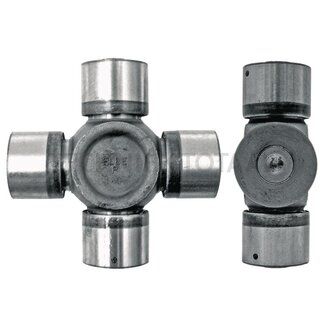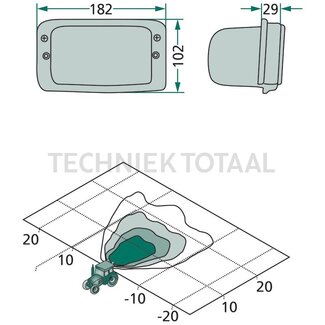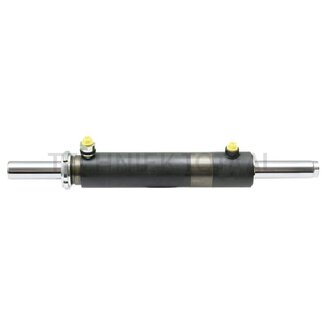
Looking for parts for your Fendt Favorit 716 (Typ 716) tractor? In this category, you'll find everything you need for the maintenance and repair of your vehicle.
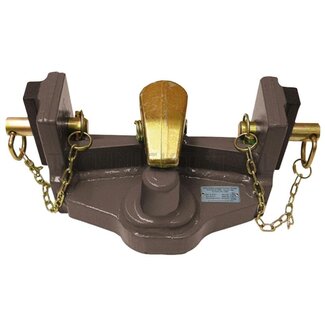
The Fendt Favorit 716 Vario was built between 1998 and 2003 and is part of the Favorit 700 Vario series. After 2003, the "Favorit" name was dropped and the model continued as the Fendt 716 Vario. A total of 6,991 units of the type T 716.210 (the technical designation for the Favorit version) were produced.
The hydraulic system operates via a Load Sensing setup with a pump capacity of 110 litres per minute at a maximum working pressure of 200 bar. The rear linkage offers a lifting capacity of 8,599 kg and is configured as category III with a quick coupler. Electrohydraulic linkage control (EHR-C) is fitted as standard, including self-diagnosis and vibration damping.
The front linkage has a lifting capacity of 3,822 kp. The external hydraulic connection has a maximum flow rate of 78.5 litres per minute at a maximum pressure of 200 bar. The separate hydraulic oil reservoir has a capacity of 50 litres, of which 45 litres can be drained.
Under the bonnet sits a Deutz BF6M 2013 C, a water-cooled six-cylinder four-stroke turbodiesel with direct injection and four-valve technology. The engine displacement is 5,702 cm³ with a bore of 98 mm and a stroke of 126 mm. The rated power output is 118 kW (160 hp) at 2,100 rpm. Measured at the PTO, 112.2 kW was recorded at rated speed, with a maximum output of 121.8 kW at 1,900 rpm.
The maximum torque is 757 Nm at 1,100 rpm, with a torque rise of 48 percent at a speed drop of likewise 48 percent. The starting torque reaches 134 percent relative to the torque at rated speed. Fuel consumption at the PTO at rated speed is 30.9 litres per hour, with a specific consumption of 232 g/kWh. The fuel tank holds 245 litres (other sources state 300 litres depending on specification).
The Vario transmission is continuously variable, with no fixed gears. On the road, a travel speed of 0.02 to 55 km/h forward and 0.02 to 37 km/h in reverse is achieved. In field operation, the maximum speed is 28 km/h forward and 16 km/h in reverse. Tractive force is therefore continuously adjustable across the full speed range. The operator can choose between joystick or foot pedal control.
Four-wheel drive and differential lock are automatically engaged and disengaged based on steering angle and travel speed.
The rear PTO has three selectable speeds: 540, 750 and 1,000 rpm. A front PTO at 540 or 1,000 rpm is also available as an option. The braking system consists of a wet cardan brake and an air pressure brake at the front, and a wet integrated multi-disc brake at the rear. A spring-loaded parking brake is also fitted, with a maximum mean deceleration of 6.5 m/s² at 40 daN pedal force.
The cab (type designation 716.810, OECD no. 4/0535) is a tiltable, sprung safety cell with sound-insulated construction. The interior noise level is 72 dB(A). The cab features two doors, a roof hatch, foldout front and rear windows, and a hot water heating system with a three-speed fan. Air conditioning was available as an option.
A standard onboard computer controls functions including the linkage, PTO, hydraulics, four-wheel drive, differential lock, engine speed and cruise control.
Optional equipment included: front linkage, front PTO, front loader, front weights, engine brake, engine heater, Variotronic camera, rear window wiper, radar anti-slip, electrohydraulic external rear control (Fremdregelung), Hitch coupling system, drawbar, Variotronic-TI and Variotronic implement control. From 2003 onwards, the optional Variotronic-TI extension allowed 13 stored functions to be recalled via joystick, plus 16 sequences for four different implements.